
Strategic Watering
Applying Forest Moisture Circulation Science

What is Strategic Watering?
Strategic Watering is an applied synthesis of the science on Forest Moisture Circulation (FMC) to rehydrate droughted forests from an eco-strategic location or locations in order to help the larger forest system attract, circulate and/or catalyze cool/moist air, rainfall, and other forms of net-positive precipitation. It relies on rehydrating natural forest moisture cycling (see diagram).
Strategic Watering can easily be used to interrupt and reverse wildfire weather with a few thousand gallons deployed correctly. The strategy maximizes “forest moisture circulation”— the aerial moisture sharing embedded in trees and contiguous forest systems. By rehydrating dry, superlative trees in strategically located groves, a person or team can exponentially increase the value of their initial water inputs as it is recycled tree to tree and plant to plant.
Why Trees and Forests?
Trees and forests are evaporative-cooling towers, more or less, constantly releasing “conditioned” (cool, moist) air when hydrated. This is in part because they’re the biggest living stores of moisture on a landscape; half or more of the average tree’s weight is water when healthy. Behaviorally, trees survive and thrive by circulating moisture through the air, close to their canopies, sometimes across great distances, sharing with each other from place to place. In so doing they create the weather we love: calm, cool and productive. Yes, bigger is better. Bigger trees move more water through the air than small ones. And, the bigger a forest infrastructure and its trees, the bigger the benefits of watering trees when in drought.
How to Locate: At a forest hub, conduit or edge.
You can apply this at any scale. Strategic Watering looks at a whole forest system’s footprint, infrastructure quality, and known atmospheric moisture flows, at varying scales, then locates its primary watering site or sites inside an identifiable hub or conduit zone, such as the Eugene, Oregon area in the Pacific Northwest (demonstrated here). There are many, many locations around the world for strategic watering. Tree size is the most important factor. Both conifer and deciduous trees work.
If Going for Cooling
The watering team hydrates at least one grove of superlative trees upwind of the afflicted location, according to our Deep Watering protocol, and adds some gentle trunk moistening at the end of the process.
If Going for Rain
The watering team sets up at least two Rainmaking with Trees sites, gets to work at those sites utilizing the Deep Watering protocol, plus a few additional steps to help stimulate rainmaking, atmospheric responses.
The Deep Watering protocol is an extremely simple method of tree hydration for drought recovery: Trickle-water each tree at its trunk in a 360° pattern. Trickle 100 gallons of freshwater per 12 inches of trunk diameter where it’s widest on the tree in that 360° pattern. Your aim is to moisten and rehydrate that tree’s rootball. Trickle as close to the base of the tree as you can without touching the bark. We recommend buckets with 1/4″ holes in the rim for this process.
Moving Moisture Over Large Landscapes
Forests channel atmospheric moisture into “livable climate“, biospheric abundance, and thus life security on land. This is Earth’s reality. Choosing the right location for Strategic Watering depends on understanding aerial moisture flows, your project goals, the shape of your given forest, that forest system’s proximity to active airborne moisture flows, dominant winds, and local water availability.
Strategic Watering scales and usually brings transformative results within less than 10,000 gallons’ worth of freshwater total (half of a swimming pool). Effects vary according to level of isolation, level of dehydration, level of atmospheric drought, level of soil drought, and the varying ways conifer and deciduous forests bring precipitation, but this scale of application can be relied on for wildfire mitigation over large areas due to dehydrated living and dead forest material. Superlative old growth trees are most effective.
While Rainmaking with Trees and Deep Watering focus on addressing each tree’s individual hydration needs in a grove, Strategic Watering focuses on locating and aligning those protocols with regional, continental and global FMC flows. By working with “the biggest players on the field” (large trees) in the most advantageous locations, we maximize airborne moisture supply and sharing. However, we can also apply Deep Watering to numerous smaller trunk trees, thinking of them as segments of larger trees, to achieve similar effects.
Why Strategic Watering
Strategic Watering of forests appears to be the most effective, efficient and beneficial way to move moisture and moist air over large landscapes. How do we know this? Trees and Forests are how rivers and land life were most often established over the eons of life’s history on Earth. According to FMC science, it is the inward-creeping forests that bring atmospheric moisture inland. Without hydrated trees, continents turn to deserts. Sound familiar?
Forests and trees are 100s of millions of years older than humans and superhuman in their moisture-sharing abilities; far more advanced than we credit them for. In times of drought, trees and forests simply need gentle, careful, slow rehydration of their biological normalcy to initiate drought resolution at ever-larger scales. That’s what trees do. They are built to share, once hydrated. In Strategic Watering we simply locate upwind of where drought and high heat conditions are worst.
How Fast Until Change
Conditions are everything. For rainfall — the confluence of vegetative, soil, and atmospheric moisture statuses defines cooling and precipitation received. An exceptionally droughted system with zero atmospheric moisture cannot magically make it rain. These things have to build up. Depending on the condition of the individual trees and resources in a given forest system, living and non, and available moisture resources in the air, it can take anywhere from hours to days to see precipitation come. For cooling — the results seem to be 100% reliable. Just get your project going correctly. You should see and feel significant changes within the first 1,000 gallons, which continue to build.
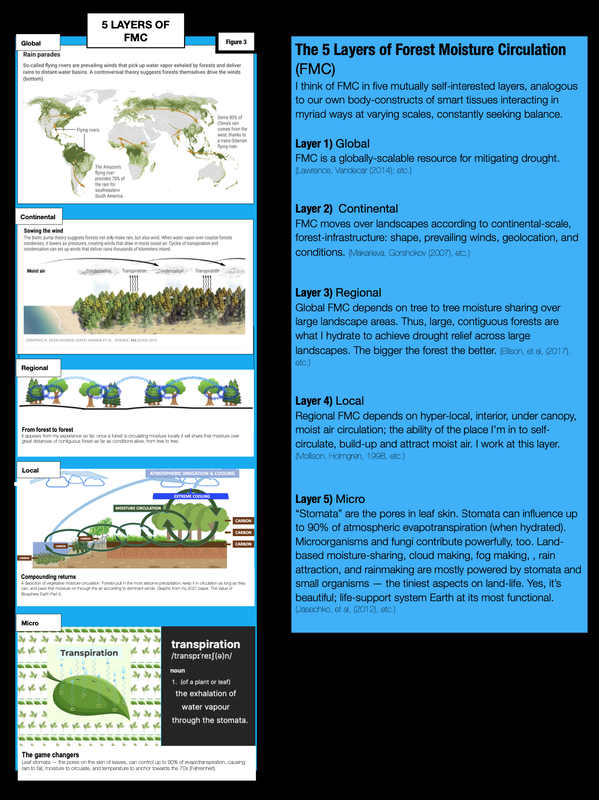
Above: The Five Layers of Forest Moisture Circulation: Micro to Global. Work with these concepts to choose your Strategic Watering location.
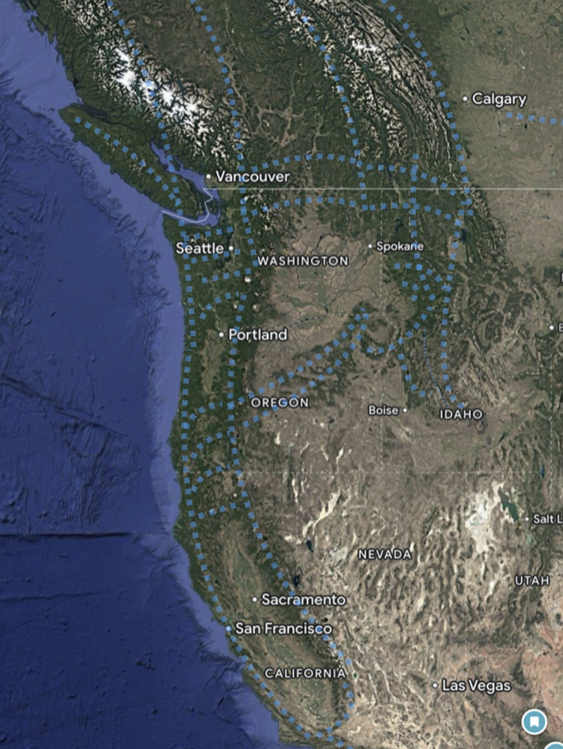
Below: A simple model identifying macro FMC paths, conduits and hubs one at continental scale in the Pacific Northwest USA. The blue dots trace aerial moisture flows over known forested areas.
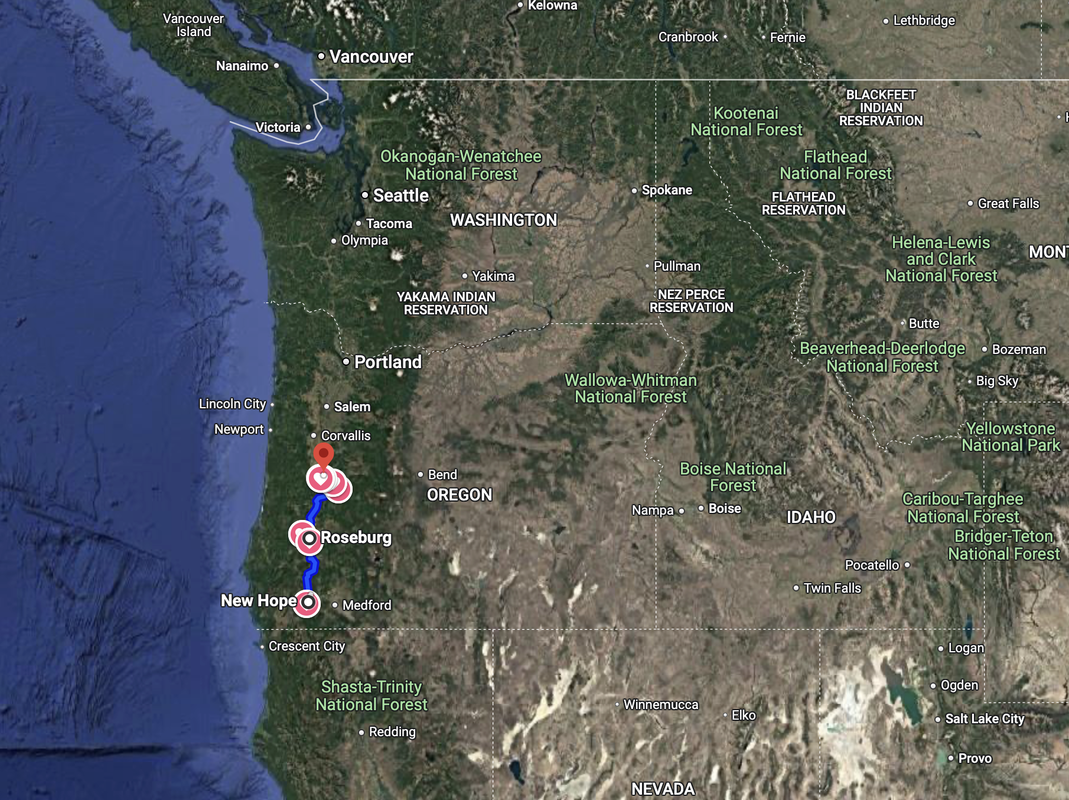
Below: Strategic Watering sites from The NorthWest Projects: 2024, our first project in the Pacific Northwest USA. Learn more in the full report.
How to do Strategic Watering
Email us for a PDF on how to do Strategic Watering.
Schedule a Job
Email us to discuss a project.
Already Doing This?
Drop us a line. We want to track what’s happening and build community.
Learn more
Here are +100 scientific studies on biogenic moisture circulation.